Healthcare Facilities
Healthcare facilities operate around the clock, under intense pressure, and with minimal tolerance for errors.
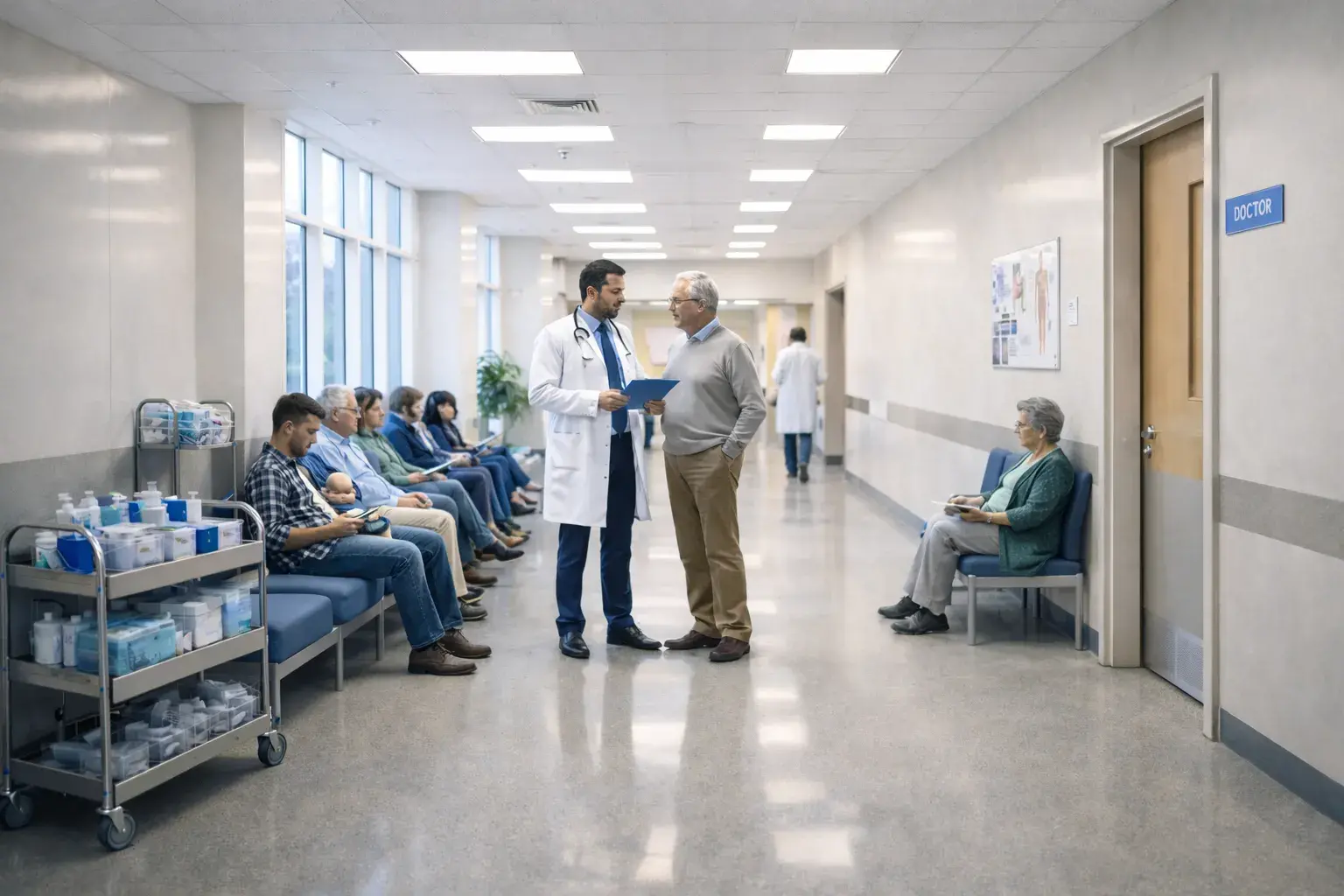
Healthcare facilities operate under constant pressure and with minimal tolerance for errors.
Every security incident (whether it involves aggression, a failure in access control, a data breach, or a crisis situation) immediately impacts operations, patient care, and management accountability.
Healthcare is among the most complex operations of all. It combines public accessibility, work with vulnerable individuals, high demands on staff, and sensitive information. Experience in recent years shows that problems do not arise due to individual failures, but due to the unpreparedness of the system as a whole.
SIHASO helps healthcare facilities manage safety as a structured process.
We work not only with leadership but with all levels of operations. From management through key roles to frontline staff. We design safety systems to be clear, functional, and practical in real-world settings.
Our approaches are based on experience from environments where similar risks have been systematically addressed for decades. We transfer this know-how to the Czech healthcare sector in a way that respects local realities, operational constraints, and management responsibilities.
What We Offer Healthcare Facilities
-
Comprehensive Site Security Assessment
We analyze facilities, key work areas, access controls, personnel movement, visitors, operational routes, and technical security measures. We identify vulnerabilities and provide clear recommendations for remediation.
-
Threat and Incident Analysis (OSINT)
Our risk assessments are based not only on local insights but also on trends in healthcare, crime, and attacks on soft targets in the Czech Republic and abroad.
-
Review of technical and electronic security systems
We evaluate electronic security systems (ESS), access control systems (ACS), camera systems, emergency devices, staff response procedures, visitor protocols, and emergency preparedness.
-
Interviews with key employees
Security is a part of daily operations. We speak with people who are in contact with patients and the public, and we compare established rules with the reality on the ground.
-
Assessment of the effectiveness of security measures
We don’t focus on what is “installed,” but on what actually works. We review facility security, access control, CCTV systems, emergency mechanisms, visitor policies, and staff readiness to respond to non-standard situations.
-
Review of crisis plans and procedures
We verify whether documentation aligns with actual operations and whether it is usable in a crisis situation. Where necessary, we propose clarifications regarding roles, decision-making authority, and procedures.
-
We will deliver a clear and professional document containing:
a) key risks and vulnerabilities,
b) clear priorities,
c) specific recommendations and corrective actions,
d) a proposal for long-term security management
-
Presentation of findings and decision-making support
We will review the results with management, explain the context, and help translate recommendations into practical decisions—without unnecessary technical complexity.
When do healthcare facilities most often turn to us?
- When preparing or updating a crisis and security plan,
- in connection with the expansion, renovation, or change in the facility’s operations,
- following a security incident, when there is a need for an independent assessment of the situation and procedures,
- when there is a need for an objective assessment of the security level for management or the facility’s operator,
- before investing in security technologies or when changing suppliers,
- in response to requirements from regulatory authorities, insurance companies, or auditors.
Benefits for hospitals and clinics
- A clear overview of the actual level of facility safety,
- higher protection of employees, patients and visitors,
- better management of emergency situations without disrupting normal operations,
- comprehensible data for decision-making by management, founders and supervisory authorities,
- higher resilience of workplaces to aggression, incidents and operational risks.